---
title: "X MCP: let an AI agent research and post on X"
description: "How an AI agent searches, reads and posts on X through an MCP server: the paid API at 0.005 USD per read, xAI's X Search, or a browser signed in to you."
canonical: "https://scalebrowser.net/blog/x-mcp"
last_modified: "2026-10-13"
published: "2026-10-13"
author: "elias"
category: "use-cases"
---
> ## Documentation Index
> Fetch the complete documentation index at: https://scalebrowser.net/llms.txt
> Use this file to discover all available pages before exploring further.
# X MCP: let an AI agent research and post on X
> How an AI agent searches, reads and posts on X through an MCP server: the paid API at 0.005 USD per read, xAI's X Search, or a browser signed in to you.
You want to know what developers said about a launch this week, and all you have is Claude. Claude cannot see X on its own: unless something connects it, the answer comes from what it already knows. That connection is an X MCP server.
## What is an X MCP server?
An X MCP server is a program that gives an AI app such as Claude Desktop a set of tools for reaching X. MCP, the Model Context Protocol, is the standard way an AI app calls tools; the server is whatever sits on the other end. There are three kinds, and they differ in what they cost per post and in what they can do.
| Kind | What it reads | Per 1,000 posts read | Posting |
| --- | --- | --- | --- |
| A server on the paid X API | posts, users, lists, through X's endpoints | 5 USD | 15 USD per 1,000 posts, 200 USD with a link |
| xAI's X Search tool | X posts, users and threads, for xAI's models | tokens plus tool calls, no per-post price | not described |
| A browser signed in to your account | what you see: search, threads, replies | a plan price, no per-post price | as you would, from your account |
The first row's prices come from X's pricing page, and the second row from [xAI's tool documentation](https://docs.x.ai/docs/guides/tools/overview), which says X Search covers "X posts, users, and threads" and bills "token usage" and "tool invocations"; we read both on 11 October 2026. The per-1,000 figures are our arithmetic on those prices.
## What does the X API cost for reading?
The X API charges 0.005 USD for each post it returns, so reading 10,000 posts costs 50 USD. X's [pricing page](https://docs.x.com/x-api/getting-started/pricing) states that price, and its [changelog](https://docs.x.com/changelog) dates the start of pay-per-use at 6 February 2026, after a closed pilot announced on 20 October 2025.
Creating a post costs 0.015 USD per request, or 0.200 USD when the post contains a URL. A server built on the API therefore needs credits in a developer account before its first call. The other prices, the monthly cap and what became of the free tier are on the X API pricing page, not repeated here. What 10,000, 100,000 and 1 million reads add up to is worked out in [the cost of reading X](/blog/x-api-pricing).
## What can an agent do on X through a browser?
An agent in [X through a browser MCP](/blog/browser-mcp) works the site the way you do, so it can do whatever your signed-in account can. These are prompts you could give it:
- "Search for `browser agent` with advanced operators, newest first, and list the ten posts with the most replies."
- "Open this thread and read every reply. What do people ask most?"
- "Check what these 20 accounts posted today and give me one line each."
- "Post this, attach the picture in my folder, and reply to the first three answers."
- "Save my bookmarks to a file, one line per post."
Search was behind a sign-in when we checked on 11 October 2026, and the run further down shows what a logged-out agent gets instead.
### How does the agent sign in to X?
The agent signs in to X with a password it never sees and a code it reads from the profile's own inbox. The browser layer below the agent types the password; the agent only names which login to use. If X asks for a code by email, the agent reads it from the mailbox bound to that profile. We describe the four sign-in walls and how a profile answers each in [the agent's own X account](/blog/ai-agent-login).
## What does an X research run look like?
A research run is one question, a handful of page loads and a summary at the end. We have no X account, so on 11 October 2026 we ran the logged-out version: the question "what did Anthropic, OpenAI and NASA post this week?" and one search, on a headless Scalebrowser profile. It opened each profile three times and the search four times, 13 page loads in about 4 minutes of wall-clock time.
| Page | Loads | Posts the agent could read | What else it met |
| --- | --- | --- | --- |
| x.com/AnthropicAI | 3 | 5 each time | the page ends, a bar offers the full profile |
| x.com/OpenAI | 3 | 5 each time, the first pinned | the same bar |
| x.com/nasa | 3 | 5 each time | the same bar |
| x.com/search?q=browser agent | 4 | 0 | 3 sign-in dialogs, 1 error page |
What came back to the reader was one line per account, built from the 15 posts it could see. Anthropic: 5 posts from 7 to 10 October, the newest about a report on unintended model actions seen in evaluations. OpenAI: 5 posts from 30 September to 7 October, the newest, pinned, about GPT-6 and Intelligent UI rolling out in ChatGPT. NASA: 5 posts from 9 October to an hour before the run, the newest a Hubble image of a galaxy cluster.
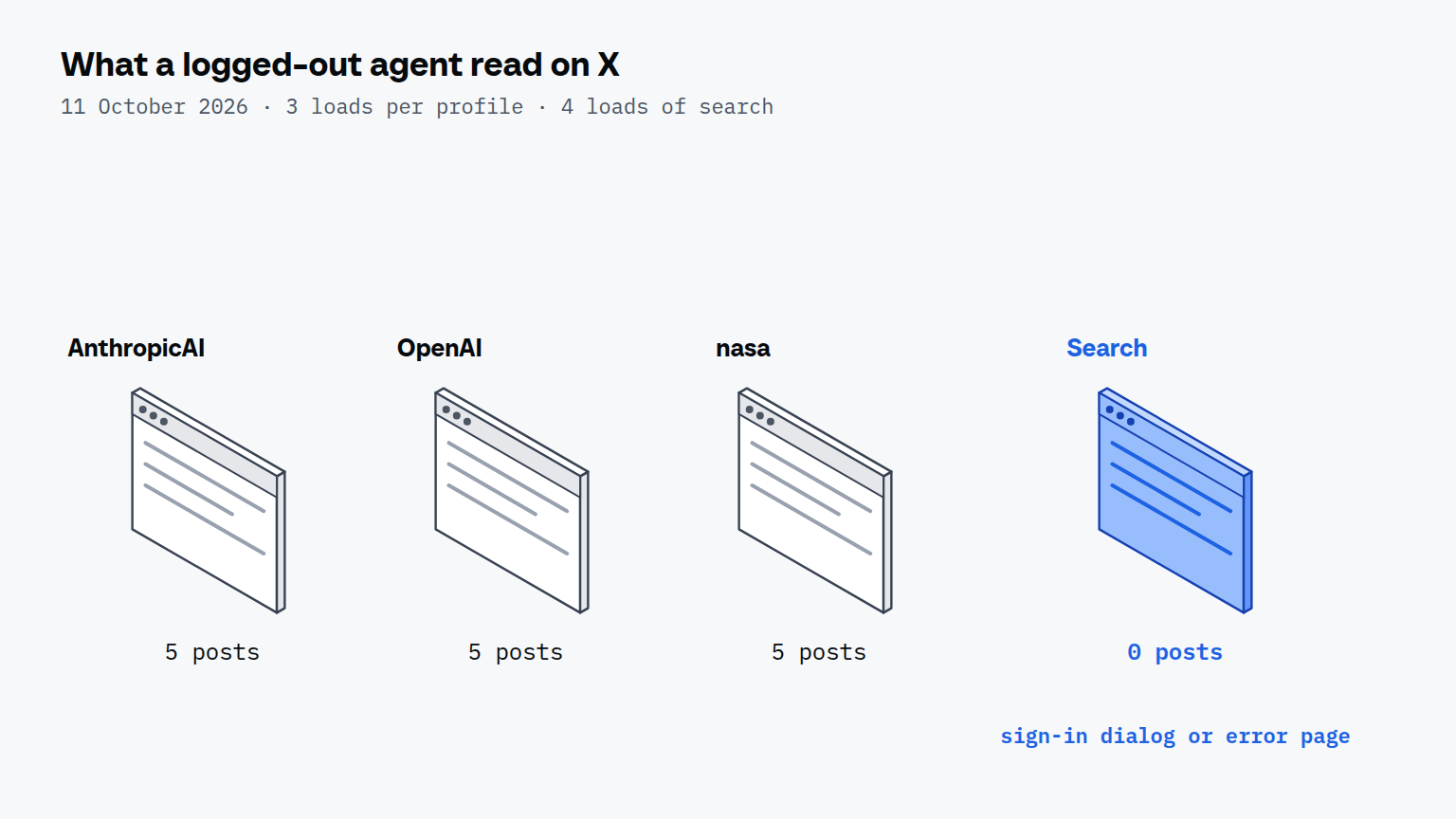
The search is where the run stopped being research. All 4 loads ended at a sign-in or an error, so a question that needs search needs the signed-in profile, and we have not measured that part. A question that needs X together with Reddit and LinkedIn is [research across Reddit, X and LinkedIn](/blog/market-research-ai), where a fetch tool read 0 of 3 X posts.
### Is Grok the only AI that can read X?
No. Grok has its own door in xAI's X Search tool, but any agent with a browser can read what its browser can read. Signed in, that is what you read; logged out, it was 5 posts per profile in our run.
### Which X MCP fits which job?
A dashboard that pulls millions of posts belongs on the API, and a person who researches or posts from their own account fits the browser. The difference is who has to keep the connection alive and how the cost grows.
| Job | Fits | Why |
| --- | --- | --- |
| A dashboard pulling millions of posts a month | API server | billed per post at 0.005 USD, 3 million reads a month before Enterprise |
| Following a topic and replying from your account | Signed-in browser | a plan price; search, threads and replies as you see them |
| A glance at a few public profiles | Logged-out browser | 5 posts per profile, no account needed |
| Asking questions of X with an xAI model | xAI's X Search | billed on tokens and tool calls |
If you are still choosing between servers, what an MCP server is covers the parts they all share.
#### Where does the browser run?
The browser runs on your own machine, so [the browser an X run uses](/blog/ai-agent-browser) keeps your account's sign-in there. For the job pages that go with this one, see the [use cases overview](/use-cases) and [agents that sign in](/use-cases/agents-that-sign-in).