Facebook Marketplace API doesn't exist: find deals anyway
Facebook Marketplace has no public API for buyers or sellers. What an AI agent does instead: search, watch for deals, list items, and what a visitor sees signed out.

Elias Auer · Researcher, Scalebrowser
Published Oct 13, 2026 · 6 min read
Short answer
On a Sunday morning you want a used road bike for under 400 USD, close enough to ride home. You type "road bike" into Marketplace, scroll, and check again every evening so nobody beats you to the good ones. In a New York search we ran on 11 October 2026, 11 of the first 18 listings cost less than 400 USD, not counting one ad for bike parts. By Tuesday you no longer remember which of them you have already looked at.
Is there a Facebook Marketplace API?
No, there is no Facebook Marketplace API for buyers or sellers. Meta's Marketplace developer page lists one product, Marketplace Partnerships: "Enable partners to distribute their products on the Facebook platform." It documents no interface for a person who wants to search or list. The general route for apps, the Pages API, works on Pages that the signing-in person manages, so it does not open Marketplace either. Groups are in the same position: Meta removed the Groups API on 22 April 2024, as Facebook groups, pages and messages explains.
What can an agent do on Marketplace?
An agent does on Marketplace what you do with a mouse, in the order you tell it. Marketplace's own filters for price, condition, listing date and distance are all things it can set. These are prompts you can give it:
- Find road bikes under 400 USD within 20 miles of Brooklyn and show me the 10 newest.
- Tell me when a new listing matches that search.
- Draft a message to the seller of the third bike and ask whether the frame is 54 cm.
- List my 4 items with their photos, each 10 percent below the cheapest similar listing.
- Compare these 10 prices with what the same bikes sell for on eBay.
We measured the reading half without an account. Creating a listing needs your signed-in profile, and we did not post one for this article.
How does a deal alert work?
A deal alert is one recorded search that your agent replays and compares with the last round. Scalebrowser has 3 workflow tools for this (record, compile and run), and the steps are:
- Run the search once with the filters you care about while the agent records the steps.
- The agent compiles the recording into a routine. What you typed, such as "road bike" or a price limit, becomes a slot you can change, and the routine stores no password and no pause lengths.
- Each time you or a scheduler of your own asks for a round, the routine replays on your profile. It finds every element again by its role and name, and every pause is drawn fresh.
- The agent compares the listing numbers with the last round and sends you only the new ones as a short message.
Every Marketplace card links to a listing with its own number, and that number is what makes step 4 a plain comparison. A home search works the same way with each home's address in place of the number, as reporting only new Zillow homes describes. Some cards also carry the page's own "just listed" tag.
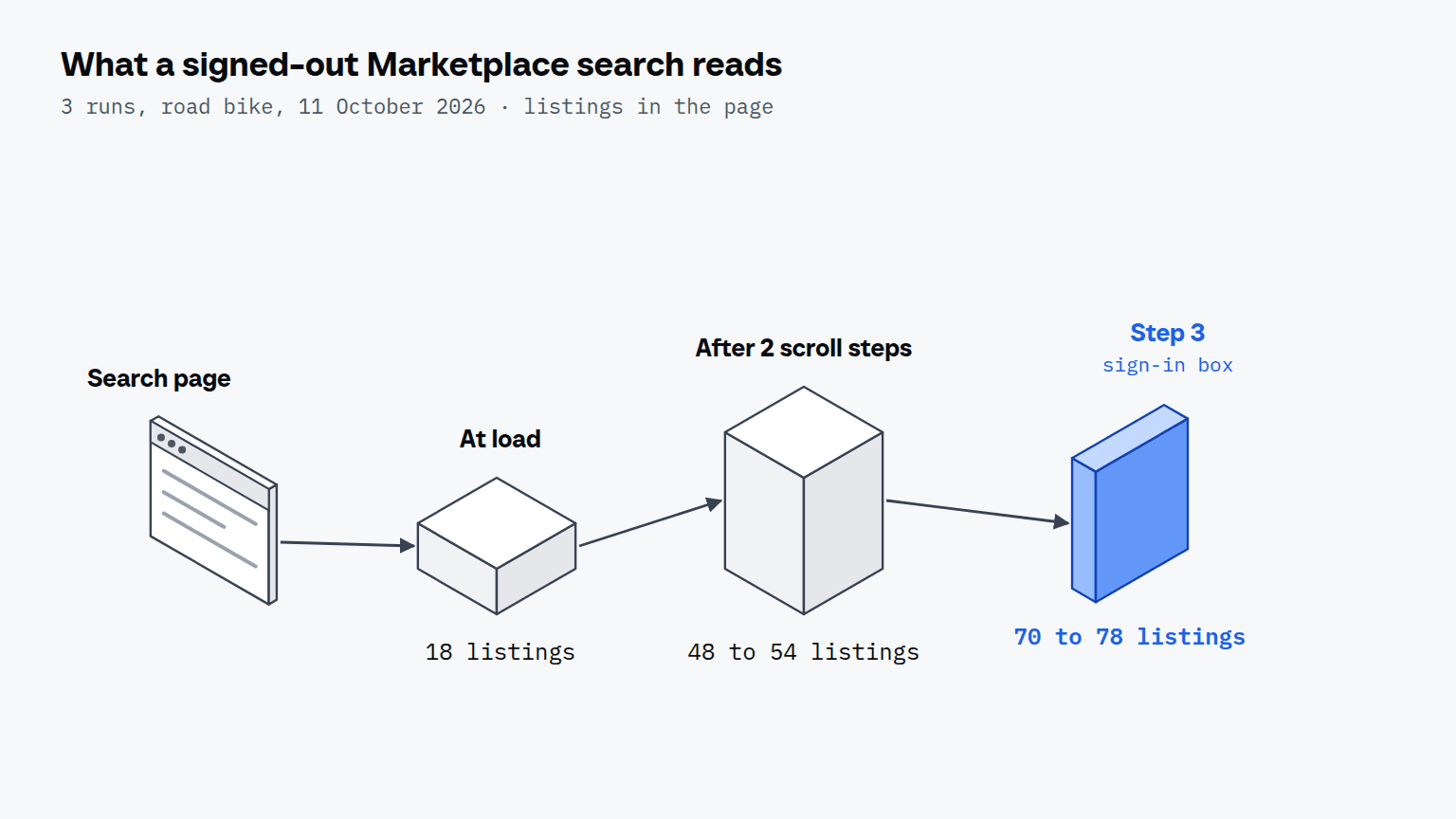
What does a round read when nobody is signed in? We measured that half on 11 October 2026 with a fresh profile, no account and the pages any visitor loads: three searches for "road bike", one per city.
| Run | City | Listings in the page at load | After 1 scroll step | After 2 steps | After 3 steps |
|---|---|---|---|---|---|
| 1 | New York City | 18 | 30 | 48 | 70, sign-in box back |
| 2 | Chicago | 18 | 36 | 54 | 72, sign-in box back |
| 3 | Los Angeles | 18 | 36 | 54 | 78, sign-in box back |
In all 3 runs a sign-in box covered the results from the first moment, and in run 1 the mouse wheel did not move the page while it was open. After we closed it the page kept loading, up to 54 listings by the second step. The box came back on the third step each time. A scroll step is one wheel gesture: 600, 900 and 1,500 pixels in run 1, and 1,000 pixels each in runs 2 and 3, and the counts are listings in the page, read from the page map.


Scalebrowser gives each agent its own isolated browser with a persistent identity, on your own machine, so a run stays signed in, handles the captcha and finishes without anyone watching it.
See how Scalebrowser does itAn alert that needs more than a signed-out visitor gets runs from your signed-in profile. We did not measure that side here.
How does the agent sign in to Facebook?
The agent signs in to Facebook with a password it never sees. The password sits in the profile's vault and Scalebrowser types it into the field, a code that arrives by email is read from the profile's own mailbox, and an authenticator code is calculated inside the profile. How a run gets through second factors, emailed codes and passkeys is written up in Facebook sign-in for an agent. We used no Facebook account for this article, so that page holds the general method and not a Facebook run.
Why does location change the results?
Marketplace builds every search around one city and a radius, so the city has to be the one you mean. In our runs the address named the city and the page answered with it, "New York City", "Chicago" and "Los Angeles", each with a radius of 65 km, about 40 miles. A fourth search with no city in the address was sent to San Francisco, a city our connection was not in. The agent therefore names the city in the address, and local results through a mobile exit explains what an exit in that city changes and what it does not.
Can the same agent search eBay, Craigslist and Kleinanzeigen?
Yes, the agent opens each site in its own tab of one profile and brings the results back as one table. You ask once, for example "compare road bikes under 400 USD on Marketplace and eBay", and read one answer.
eBay is the large one. It reported 136 million active buyers for the second quarter of 2026 in its release of 5 August 2026, and it counts a buyer as active when they paid for a transaction in the previous 12 months.
Craigslist publishes no public search API, and its terms of use put any use of its API behind a separate licence from Craigslist. The agent opens its search pages as you do.
For German-speaking readers, Kleinanzeigen in Germany and Willhaben in Austria are ordinary websites that an agent opens the same way. We did not measure either one for this article.
Where does the browser run?
The browser runs on your own machine, so the Facebook session stays in a profile there; the browser that runs the search is described in the article on browser agents. For the other jobs an agent's own browser takes on, see the use cases overview and tools with no API.
Run it on your own machine
Seven days to try it with your own agents on your own sites. Starting the trial needs a card.
Written by
Elias Auer
Researcher, Scalebrowser
Researcher at Scalebrowser, the browser layer for AI agents that runs on your own machine. Measures what a web page can observe about a browser, compares it with a real Chrome on the same machine and publishes the numbers, including the ones that went against us.
All articles by Elias Auer