Facebook MCP: an AI agent for your groups, pages and DMs
A Facebook MCP server on Meta's Graph API cannot reach groups since 22 April 2024. What a browser signed in to your profile reads, and what 4 signed-out runs showed.

Elias Auer · Researcher, Scalebrowser
Published Oct 17, 2026 · 5 min read
Short answer
A community manager answers the same question in 6 Facebook groups every week, pasting the same three sentences and changing the greeting. She asks an agent to take it over and is told that the usual route, Meta's Graph API, cannot reach groups at all. The agent can still do the job, but through a browser signed in to her profile and not through an API. Here is what that means for groups, pages and messages.
What is a Facebook MCP server?
A Facebook MCP server is a program that gives an AI agent tools for Facebook, such as "read this group" or "reply to this message", through the Model Context Protocol. Two designs exist, and they reach different parts of Facebook:
| Design | Groups | Pages | Messenger | Personal profile |
|---|---|---|---|---|
| Graph API or page tool | none since 22 April 2024 | Pages you manage, most features after Meta's app review | the page inbox, by permission | not covered by the Pages API |
| Browser signed in to your profile | the groups you belong to | the pages you manage or follow | your chats and the page inbox | yes, it is your own account |
The first row follows Meta's own Pages API documentation, which describes access to "a Facebook Page's settings and content" for Pages the signing-in person manages. The second row describes what a person can do in a browser, and an agent in that browser can do the same.
What happened to the Facebook Groups API?
Meta removed the Facebook Groups API and the publish_to_groups permission with Graph API v19.0, effective 22 April 2024 for all versions. The v19.0 changelog lists the permissions that were discontinued. A Facebook MCP server built on the Graph API therefore cannot read or post in a group, whatever its tool list says, and that is the whole reason the groups half of the work moves to a browser.
What can an agent do on Facebook through a browser?
Through a signed-in browser an agent works as you do, and an MCP server that drives Facebook is a browser MCP server pointed at facebook.com. These are prompts you can give it:
- Find the new questions in my 6 groups since Monday and list them with a link.
- Post this announcement in the 2 groups that allow it.
- Answer the messages in my page inbox that ask for opening hours.
- Copy the date, place and ticket link of next month's events into a sheet.
We measured the signed-out half, which is the reading. Posting and answering need your signed-in profile, and we used no Facebook account for this article.
How does the session stay signed in?
The session stays signed in because the profile keeps its cookies between runs, and the profile syncs between your own machines at every stop and every 15 minutes. What the agent may know about those cookies, and why it never reads their values, is in the cookies of a Facebook session. The sync is encrypted and runs between your machines only. WhatsApp, Meta's chat app, is kept the same way: WhatsApp Web with a QR link stays linked in the profile and syncs between your machines every 15 minutes.
What does a group watch run look like?
A group watch run opens the group, scrolls a few screens and lists every post that asks something. On 11 October 2026 we did that signed out on a public Python group, which showed 902,440 members at the first read and 902,444 about 20 minutes later. The run took about 25 seconds from the request to the last read, the agent's own turns included.
The group's feed held 7 posts after 3 scroll steps, dated from 4 days earlier back to 21 March 2023, and the agent read the page's text for question marks. It found 5 passages that ended in one, and 3 of them asked how to scrape a site that blocks the scraper or how to run several browsers behind proxies. We wrote no drafts and posted nothing; both need your own signed-in profile.
| Target | Runs | Readable at load | Sign-in box | After 3 scroll steps |
|---|---|---|---|---|
| Public page (American Hiking Society) | 1 | name, 252,583 followers, intro, address, phone, email, website, 1 post | over the page at load | 6 posts in the page, box back on step 3 |
| Public page (NASA) | 1 | page name and a post from 1 hour earlier | over the page at load | not scrolled |
| Public group (Python, 902,440 members) | 2 | name, member count, description, a featured post with its first comment | none | 7 posts back to 21 March 2023, no box |
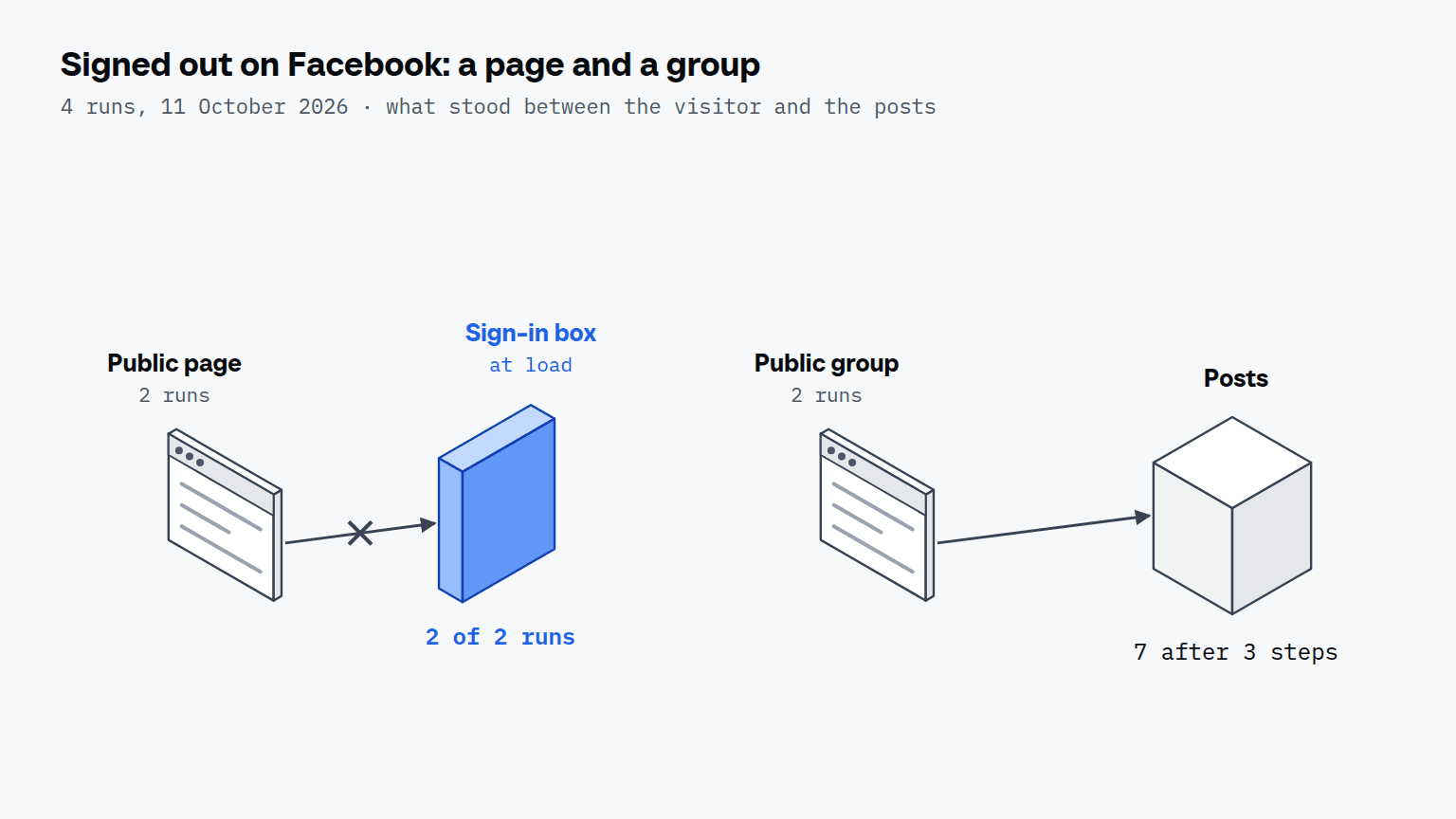
The group page also says so itself. In the page's own words, translated from German, a public group means "Anyone can see the group's members and their posts", and the page offered a "Join group" button. Whether a private group shows anything signed out was not part of our runs.


Scalebrowser gives each agent its own isolated browser with a persistent identity, on your own machine, so a run stays signed in, handles the captcha and finishes without anyone watching it.
See how Scalebrowser does itWhat about Marketplace?
Marketplace is the part of Facebook with no API at all, and the agent works it in the same profile: a signed-out search showed a sign-in box from the first moment in 3 of 3 runs, with 18 listings in the page, as measured in the Marketplace side of Facebook.
Where does the browser run?
The browser runs on your own machine, so the Facebook session stays in a profile there; a browser signed in to Facebook is described in the article on browser agents. For the other jobs an agent's own browser takes on, see the use cases overview and agents that sign in.
Run it on your own machine
Seven days to try it with your own agents on your own sites. Starting the trial needs a card.
Written by
Elias Auer
Researcher, Scalebrowser
Researcher at Scalebrowser, the browser layer for AI agents that runs on your own machine. Measures what a web page can observe about a browser, compares it with a real Chrome on the same machine and publishes the numbers, including the ones that went against us.
All articles by Elias Auer