
rebrowser-playwright: 24 of 31 targets and 5 blocks
rebrowser-playwright in September 2026: what its patches change in Playwright, why it matched vanilla Playwright on 24 of 31 targets, and what to use instead.

Davide Valli · Founder, Scalebrowser
Published Nov 19, 2026 · 6 min read
Short answer
You have Playwright code that works until a site with a bot defence looks at it, and rebrowser-playwright promises a fix without a rewrite: change the package name, keep the API. Its patches target one of the best-documented automation traces there is. We read the patches and the packages on 27 September 2026 and set them next to a public benchmark that ran rebrowser-playwright on 31 live targets.
What is rebrowser-playwright?
rebrowser-playwright is the original Playwright package with the rebrowser patches applied, published under its own name on npm and PyPI so that existing code runs unchanged. The patches live in a separate project, rebrowser-patches, which edits the source of an installed Puppeteer or Playwright; the drop-in packages are that edit done in advance. Each major and minor version is meant to match the upstream Playwright release.
| Package | Latest version | Released | Downloads |
|---|---|---|---|
| rebrowser-playwright, npm | 1.52.0 | 9 May 2025 | 22,251 in the week to 26 September |
| rebrowser-playwright, PyPI | 1.52.0 | 9 May 2025 | 76,740 in the last month |
| rebrowser-patches | 1.0.19 | 9 May 2025 | 1,435 GitHub stars |
| playwright, npm | 1.63.0 | 4 September 2026 | 111,220,550 in the week to 26 September |
The drop-in package stopped at Playwright 1.52.0, and by 27 September 2026 upstream had shipped 11 minor versions since. The patches' own README lists 1.52.0, released on 17 April 2025, as the latest fully tested Playwright version.
What do the rebrowser patches fix in Playwright?
The rebrowser patches fix two things in Playwright: the Runtime.enable leak and the default name of Playwright's utility world. Automation libraries send the DevTools command Runtime.enable to every frame so they can run code there, and the README says a page can detect that command with "a few lines of JavaScript", a technique it describes as "used by all major anti-bot software". The patch stops the automatic call and creates execution contexts another way, by default through a binding in the main world, with an isolated world as the alternative.
The second patch lets you rename the utility world, and for Puppeteer a third one changes the //# sourceURL=pptr: tag that Puppeteer appends to evaluated scripts. The patches work "only for Chrome for now", and page.pause() does not work with the fix enabled. The maintainers state the limit themselves: the fix alone does not hide a browser, and the rest is up to you.
You need to address many other aspects such as proxies, proper user-agent and fingerprints (canvas, WebGL), and more.
Is rebrowser-playwright detected by Cloudflare?
Yes, on the Cloudflare targets of a public benchmark that ran it. Ian L. Paterson tested 7 tools against 31 targets in three sweeps from one residential address and published the results on 13 May 2026, 651 verdicts in all. rebrowser-playwright was blocked on a site behind Cloudflare Turnstile and on a Cloudflare interstitial, and its overall result matched vanilla Playwright exactly.
| Tool | Browser in the test | OK, gated, blocked of 31 |
|---|---|---|
| nodriver | Chrome 148 | 28, 3, 0 |
| CloakBrowser | Chromium 145 | 26, 3, 2 |
| Patchright | Chrome 148 | 25, 3, 3 |
| Camoufox | Firefox 135 | 25, 3, 3 |
| vanilla Playwright | Chromium 147 | 24, 2, 5 |
| rebrowser-playwright | Chromium 136 | 24, 2, 5 |
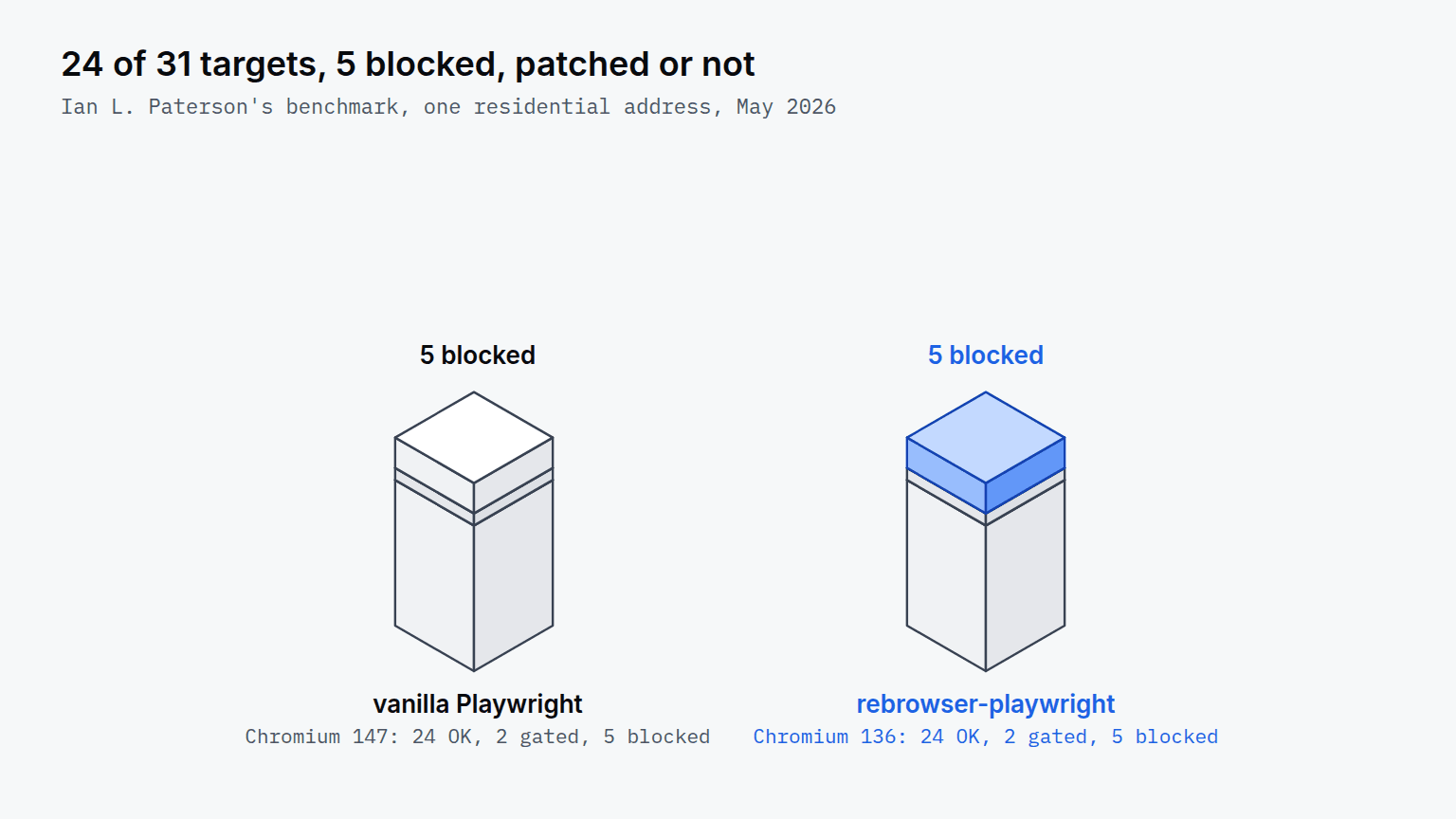
Paterson notes that the two Playwright rows have identical block sets, and that rebrowser-playwright "ships Chromium 136, eleven versions behind vanilla's Chromium 147". A second view comes from Evomi, a proxy vendor, whose benchmark of 5 May 2026 saw the patches raise the CreepJS score from 49 to 71 of 100 against stock Playwright, while Cloudflare Bot Management still flagged the patched browser on behaviour. The patches improve what a fingerprinting page reads, and the sites that block kept blocking. How a client that sends requests without JavaScript compares with a real browser is covered in curl_cffi vs a real browser.
Why do Playwright patches hit the same wall?
Playwright patches hit the same wall because they change what Playwright sends to the browser and keep Playwright as the thing that sends it. Paterson's reading of his own data is that "Playwright forks fail regardless of patch quality, and defeating that layer takes a control plane that is not Playwright". Patchright, which also hides Runtime.enable and is maintained, reached 25 of 31 in the same test, one target more than vanilla Playwright. Our comparison of patched Playwright builds and the other free tools sorts them by the layer they change for that reason. The UC Mode and CDP Mode of SeleniumBase are covered in SeleniumBase UC Mode and CDP Mode.
The input is a layer the patches do not touch at all. On our signature bench on 24 August 2026, playwright-core 1.62.1 typed capital letters without pressing Shift in type(), and fill() inserted the whole text at once with no key events, 2 runs each. rebrowser-playwright inherits both, because it changes how Playwright talks to the page's JavaScript, not how it types.

Scalebrowser runs real browser profiles on your own PC: your AI agent drives them over MCP and signs in without ever seeing a password.
Download freeWhat should you use instead of rebrowser-playwright?
For Playwright code you want to keep, use a maintained patched driver on a current Chrome; for work on sites that block both, change the control plane. The table sorts the options by what you already have.
| Situation | Pick | Why |
|---|---|---|
| Playwright code, patches wanted, current Chrome | Patchright | released 1.63.0 on 8 September 2026, 25 of 31 in Paterson's test |
| Playwright code already on rebrowser-playwright | plan the move | frozen at Playwright 1.52.0, same result as vanilla Playwright |
| New Python code for sites with Cloudflare Turnstile | nodriver | the only tool without a block in Paterson's test |
| An agent that signs in, types and keeps accounts | a browser with its own input path | Playwright's typing and filling leave the traces above |
The Playwright migration guide shows how existing Playwright code first attaches to a different browser unchanged, and how strict targets then move to an input path that types like a keyboard. A tool that runs a JavaScript interpreter instead of a browser is covered in cloudscraper.