

reCAPTCHA v2 checkbox: an agent gets the same puzzle
What happened when an AI agent clicked the reCAPTCHA v2 checkbox on Google's demo: the same image puzzle as a control browser, 2 grid types solved, audio in 1.3 s.

Davide Valli · Founder, Scalebrowser
Published Nov 20, 2026 · 6 min read
Short answer
The reCAPTCHA v2 checkbox is the challenge an agent meets most often, and the first question about it is whether the agent gets the picture puzzle where a person would not. We clicked it with our engine and with ordinary Chrome on Google's own demo page in August 2026, then let the agent work the puzzles it got. The two browsers were treated the same, the puzzles were solvable, and the two things that got in the agent's way were on our side.
What is reCAPTCHA v2?
reCAPTCHA v2 is Google's challenge with the "I'm not a robot" checkbox. Google's version overview describes the result of the click plainly: it "will either pass the user immediately (with No CAPTCHA) or challenge them to validate whether or not they are human". The challenge is an image grid, either 3 by 3 separate photos or 4 by 4 tiles cut from one photo, with an audio clip as the alternative. An invisible variant runs the same check without the checkbox, when the visitor presses a button of the site.
For the invisible variant, Google states that by default "only the most suspicious traffic will be prompted to solve a captcha". Whether the checkbox turns green or opens a grid is the verdict itself, and the grid is what a visitor gets after the verdict went against them.
Does reCAPTCHA v2 show more puzzles to an AI agent?
No, not on Google's demo: the checkbox opened the image puzzle for our engine and for ordinary Chrome on the same page, in the same minute, so the difference between them was zero. On the line we used in August the demo asked every browser for a puzzle, which makes the comparison a fair test of the click and the puzzle, and a weak one of the verdict.
| Run | Browser or task | What happened | Result |
|---|---|---|---|
| Checkbox | our engine | image puzzle opened | same as control |
| Checkbox, control | ordinary Chrome, same minute | image puzzle opened | same as engine |
| 3 by 3, "stairs", nine photos | agent, part of the clicks outside its tools | tiles 1, 3 and 7 at the first attempt | verified, token of 2,169 characters |
| 4 by 4, "motorcycles", one cut photo | agent, part of the clicks outside its tools | tiles 5, 6, 9 and 10 | verified, token of 2,190 characters |
| 3 by 3, "cars" | agent tools only | checkbox, 3 tiles, confirm, submit | verified |
| Audio alternative | agent tools only | clip transcribed locally in 1.3 seconds | green checkbox |
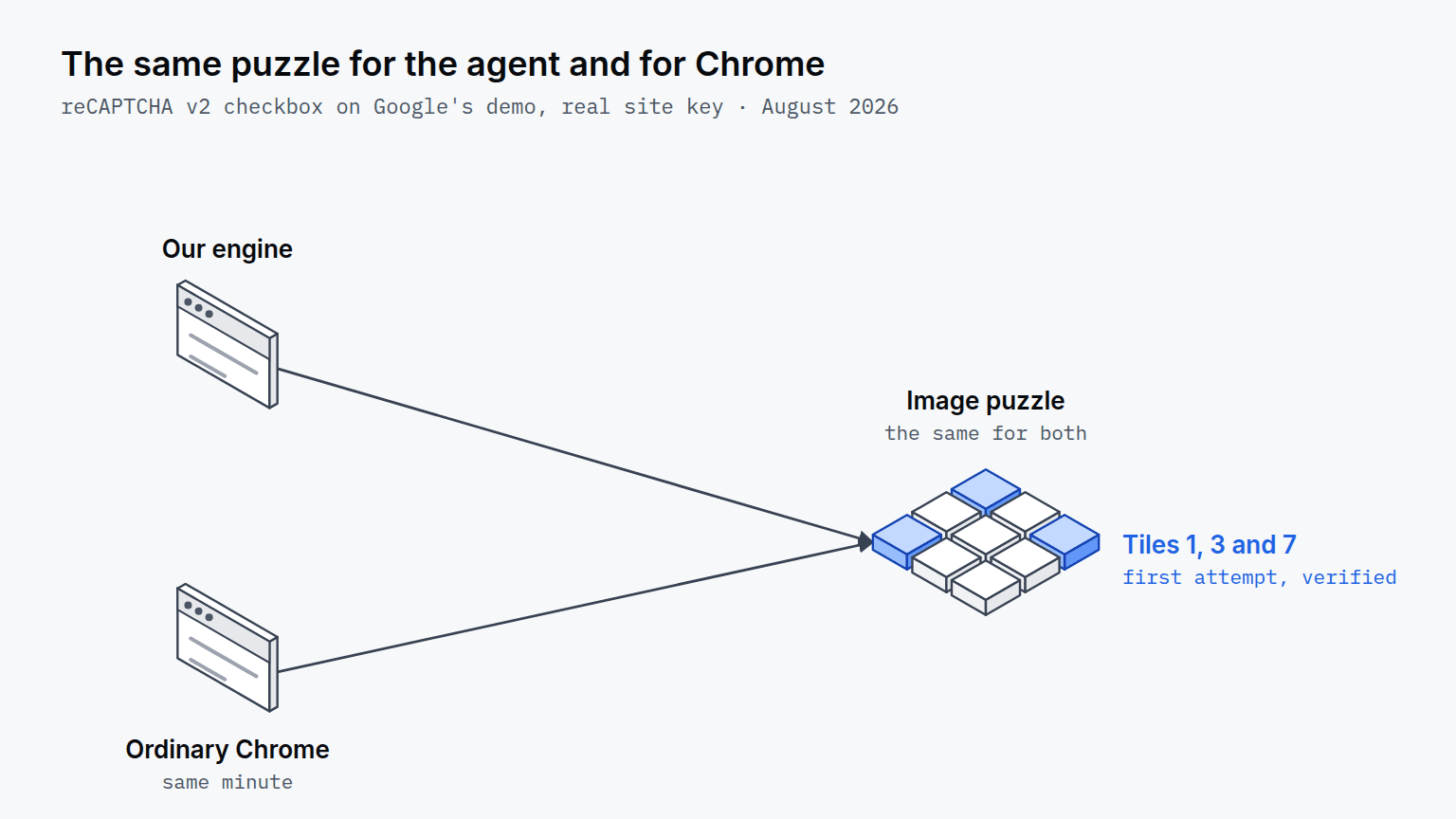
The tokens are the evidence: Google issues one only after it accepts the answer, and the demo page confirmed the grid runs with its own success message.
Can an AI agent solve the reCAPTCHA v2 image puzzle?
Yes. The agent solved both grid types on Google's demo, the 3 by 3 grid of separate photos and the 4 by 4 grid cut from one photo, and on the first 3 by 3 puzzle it picked the 3 right tiles out of 9 at the first attempt. It needs no service and no model of its own for this: the puzzle is a picture, and the agent reads pictures. It takes a close screenshot of the challenge frame alone, because on a picture of the whole page the tiles are too small to judge, decides each tile, and clicks through the same input layer that moves every other pointer.
The two earlier runs sent part of their clicks from outside the agent's tools, so they are evidence about the puzzle and not about the agent. The "cars" run went through the agent's tools alone, from the checkbox to the submit button, and it is the one we count among the challenge types an agent meets. Two details cost runs on the way. A second, displaced copy of the challenge frame sits in the page far outside the visible area, and a click aimed at the first match in the page lands nowhere. And every wrong click uses up the session: the puzzle expires and starts over, so the geometry is checked before the click, never after.
Researchers reached the same conclusion with a dedicated model. Andreas Plesner, Tobias Vontobel and Roger Wattenhofer at ETH Zurich reported in 2024 that a fine-tuned YOLO model solved "100% of the captchas" and that "there is no significant difference in the number of challenges humans and bots must solve". Their bot also got more puzzles from one address after its 19th run, and none of that escalation when it changed address. A challenge that asks for an image to be turned upright is covered in rotate captcha.
Why did the first clicks on the checkbox do nothing?
The first clicks on the checkbox did nothing because they came too early. The page reported itself loaded, the agent's map already listed the checkbox, and the click landed before the widget's frame had wired its click handler, so four attempts in a row returned no change and no error. A plain click on the same spot, sent from outside the agent's tools, opened the puzzle at once. The agent now waits after loading until the page's frames stop changing, and the same click works at the first attempt. Payment widgets and embedded players load the same way, so the fix was never specific to reCAPTCHA.
Why could the agent not see the tiles at first?
The agent could not see the tiles because the accessibility tree does not list them. Each tile is a 130 by 130 pixel cell marked as a button with a label, yet Chromium's accessibility tree for the challenge frame reported 102 nodes and not one tile among them; the five buttons it did list were the footer. An agent whose page map is built from the accessibility tree alone sees a puzzle with nothing to click in it. Scalebrowser's map now adds every element that carries an explicit operable role and a label, which is what made the tools-only run possible.
How does the audio alternative compare?
The audio alternative took 1.3 seconds to transcribe: the agent downloaded the clip, a local Whisper tiny model (39 MB) turned it into text on the same machine in that time, model loading included, and the typed answer turned the checkbox green on 14 August 2026. No speech service was called. It is still the second door. Audio is the accessibility route, a switch to it when the picture is readable is a pattern of its own, and a page that offers the picture should get an answer to the picture.
What does Google's demo not tell you?
Google's demo does not tell you how a production site would treat your agent, because the verdict depends on the address and on the site's own key. On the same demo, over 191 measurements on 9 September 2026, the checkbox turned green without a puzzle for 17 of 89 judged runs through bought mobile exits and for 0 of 70 over one home line, and a site with its own traffic history can differ again. Test the checkbox on the site you care about, through the exit you will use, and treat the puzzle rate as a property of that address. The verification documentation keeps the current status of every challenge type we have measured.