

Rotate captcha: why our agent failed at 11 of 24 positions
Why an AI agent could not pass a rotate captcha: 11 of 24 angle positions refused at 15.3 degrees per click, no network check at all, and how the angle is measured.

Davide Valli · Founder, Scalebrowser
Published Nov 23, 2026 · 6 min read
Short answer
Of the 20 challenge types our agent tried in August 2026, the rotate captcha is the one it reached and never passed, and for a while that looked like a gap in the agent. It is not. The widget can be operated, the figure can be turned upright, and the answer is refused anyway, every time, for a reason that sits in the page and not in the browser.
What is a rotate captcha?
A rotate captcha is a challenge that shows an image turned by a random angle and asks the visitor to turn it back upright, with arrow buttons or a slider. It splits into two halves. The first is a judgement: when does the figure stand the right way up? The second is arithmetic: how far does one press of an arrow turn it, and how many presses reach the angle? A person does both without noticing. A program has to do them separately, and the pages never write the second one down.
How does a rotate the image captcha work?
A rotate captcha works by comparing the angle the visitor sets with the angle the widget chose, inside a tolerance. GoCaptcha, an open-source implementation, documents the parts in its rotate captcha guide: the widget turns its image by an angle from a configured range, the example uses 20 to 330 degrees, the visitor "rotate[s] the thumbnail to the target angle", and "the backend compares the user's rotation angle with the target angle". The check takes a padding value, so an answer within that padding of the target still passes.
| Part | How it is documented | What the demo did |
|---|---|---|
| Start angle | random, from a configured range | random |
| Control | the visitor turns until upright | arrows, 15.3 degrees per click, never shown on the page |
| Positions | not specified | 24 steps for a full turn |
| Check | the backend compares with the target, with padding | no network request during the check |
| Answer | pass or fail | "Incorrect captcha angle" |
The step size is the number an agent needs and the page withholds. We measured it by capturing the figure before and after one click: 15.3 degrees, which makes 24 positions for a full circle.
Why can an AI agent not solve a rotate captcha?
Our agent could not solve the rotate captcha because the demo refuses every angle its own arrows can produce: it tried 11 of the 24 positions on 14 August 2026, covering the whole plausible range with the figure visibly upright, and all 11 were refused.
| Run | What the agent did | Result |
|---|---|---|
| First | measured 15.3 degrees per click, turned the figure upright | refused twice, "Incorrect captcha angle" |
| Systematic | tried 11 of 24 grid positions across the plausible range | all 11 refused |
| Network check | recorded every request the page made while checking | none |
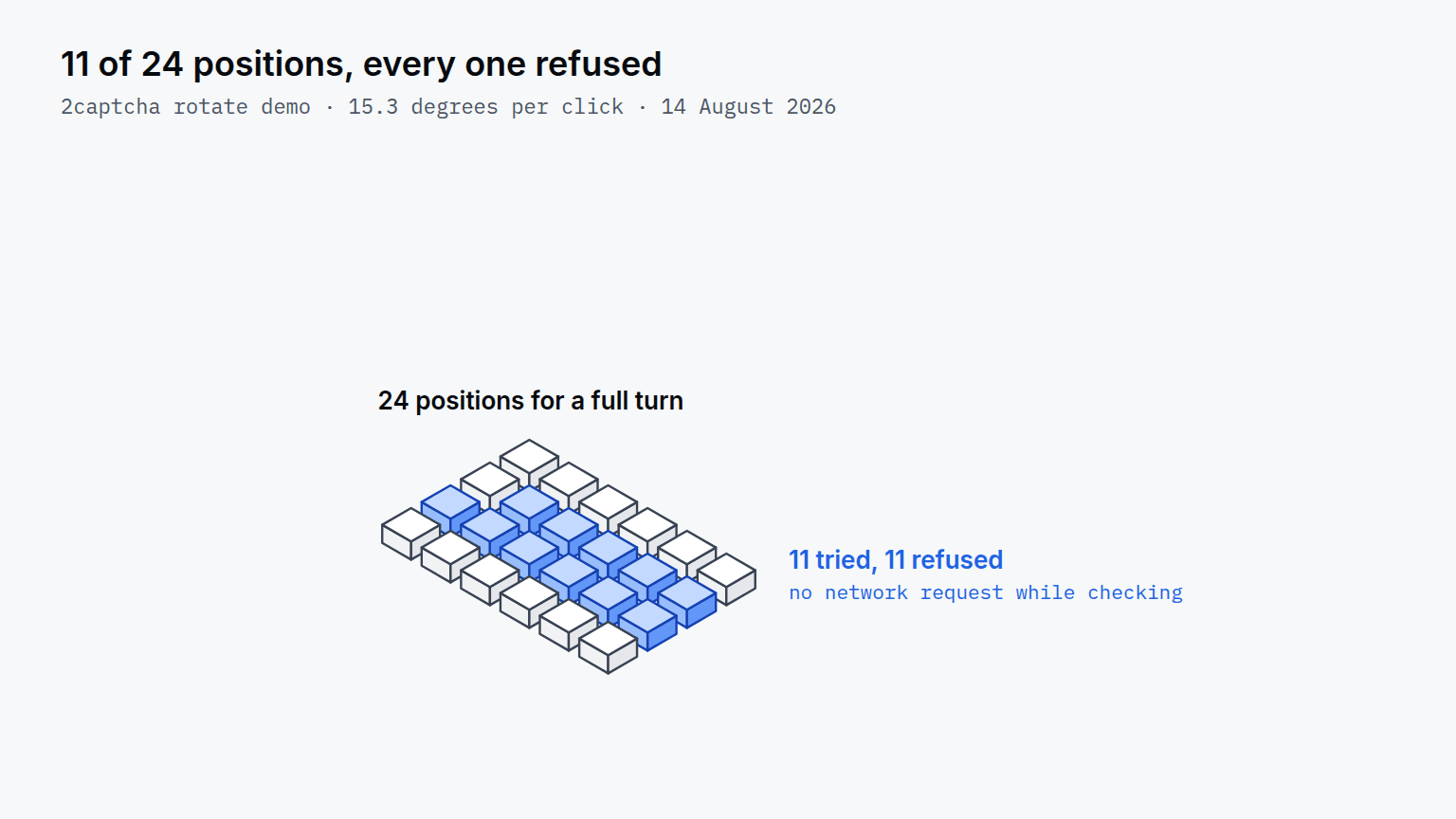
The last row decides the case. A widget that compares on a server has to send the answer there, and this one sent nothing: it compared inside the page, against a value its own controls never set. No visitor, person or program, can pass it through its interface. It stays one of the two open rows in our record of where challenge solving stops, counted as not solved rather than dropped, because a demo that refuses everyone still refused us.
How does an agent measure the angle?
An agent measures the angle by comparing two captures of the same element, one before and one after a single click, and reading the turn between them in degrees. Whether the figure is upright stays with the agent's model, which judges that better than any rule. We tested three ways of reading the turn against an image rotated by known angles, ten angles around the whole circle.
| Method | Mean error | Verdict |
|---|---|---|
| Polar profile with circular correlation, then a fine search over plus and minus 3 degrees | 0.0 degrees | chosen, 0.01 seconds |
| Trying all 360 degrees in 1 degree steps | 0.0 degrees | correct, 40 times slower |
| Main axis of the figure | 81 degrees | unusable: an axis has no direction, and a half turn is invisible |
The winner turns rotation into shift: summed along each ray from the centre, a turn of the image becomes a shift of the profile, found in one pass. On the live demo one condition showed up. The crop has to be centred on the point the image turns around. The same click read 1.0 degree at a match score of 0.73 with the wheel off centre, and 14.8 degrees at 0.94 with it centred, half a degree from the 15.3 an independent script had measured on the same page. Scalebrowser's rotation tool therefore reports the match score with every reading and warns below 0.85.
How does the free path solve a rotate captcha?
The free path solves a rotate captcha with a model that predicts the angle from one picture. rotate-captcha-crack, an open-source project with about 500 GitHub stars as of October 2026, trains a network on the COCO image set for 3.4 hours and reports an average prediction error of 7.18 degrees, with a GPU of at least 16 GB for training. That answers the judgement half in one step and leaves the arithmetic half to the caller: 7 degrees off is half a click on the demo we measured.
Neither approach passes a check that compares against a value its controls cannot reach. A trained model would have turned the demo's figure upright as well, and the page would have refused it in the same way. Where a widget does check on its server within a tolerance, as GoCaptcha documents, measuring the step and judging upright is enough.
What should you do when every angle is refused?
Stop turning and look at the network. Record the requests the page makes while it checks the answer; if there are none, the check runs in the page, and a refusal there says nothing about your agent. Measure the step size once instead of guessing it, try the plausible range once, and record the challenge as open rather than looping on it. The verification documentation keeps the rotation captcha's status next to every other challenge type we have measured, with the four measuring tools the agent uses.