

Speech synthesis voices: 40 voices, 0 at page load
How the speech synthesis voice list fingerprints a browser over time: 0 voices at page load, then 40 in real Chrome on Windows, and 21 in Chrome for Testing.

Davide G. · Founder, Scalebrowser
Published Nov 26, 2026 · 6 min read
Short answer
Nobody expects a text-to-speech API to matter for a browser that never speaks. Yet speechSynthesis.getVoices() answers without a permission prompt, describes both the operating system and the browser brand, and does so in a sequence that changes during the first milliseconds of a page. We got this axis wrong twice in our own engine and misread it twice more in our own measurements, which is why this case study treats the list as a time series from the first line.
What does speechSynthesis.getVoices() return?
speechSynthesis.getVoices() returns the list of voices the browser can use to read text aloud, one SpeechSynthesisVoice object per voice. The Web Speech API draft, dated 18 September 2026, says only that "it is user agent dependent which voices are available", and each voice carries five properties.
| Property | What it holds | What it tells a page |
|---|---|---|
name | a readable name, such as Microsoft Hedda - German (Germany) | the vendor and the installed language packs |
lang | a BCP 47 language tag | the languages the machine speaks |
localService | true for a local synthesizer, false for a remote one | the split between operating system voices and network voices |
default | whether this is the default voice | the system language |
voiceURI | an identifier of the voice | usually the name again |
The local voices come from the operating system, and the remote ones come from the browser. Together they name both. Voices from a provider rather than from the browser are covered in AI voice over for product demos.
Why does getVoices() return an empty list at first?
getVoices() returns an empty list at first because Chrome loads the voices asynchronously and announces them with a voiceschanged event, which in our readings came 1 to 29 milliseconds after the page started. The spec defines the event as "fired when the contents of the SpeechSynthesisVoiceList, that the getVoices method will return, have changed", and MDN's getVoices() example calls its function once and again from onvoiceschanged for exactly this reason. A page that wants the whole story reads the list as a series:
const start = performance.now()
const read = () => {
  const v = speechSynthesis.getVoices()
  console.log(Math.round(performance.now() - start), v.length,
    v.filter((x) => x.localService).length, v.filter((x) => x.default).length)
}
read()
speechSynthesis.addEventListener("voiceschanged", read)
setInterval(read, 1000)
In a real Chrome the first line prints 0, and the list then grows once and stays.
How many voices does real Chrome on Windows report?
Real Chrome on Windows reported 40 voices on our test machine: 21 local voices from Windows and 19 Google network voices, with exactly 1 of the 40 marked as default. On 14 September 2026 we read the list 17 times over 16 seconds in four browsers on the same Windows machine, each with its own data directory.
| Browser | At page load | After voiceschanged | Local | Network | Default voices | First voiceschanged |
|---|---|---|---|---|---|---|
| branded Chrome 153 | 0 | 40 | 21 | 19 | 1 | 1 ms |
| Chrome for Testing 154.0.8037.9 | 0 | 21 | 21 | 0 | 1 | 29 ms |
| our 154 engine, no persona | 0 | 21 | 21 | 0 | 1 | 13 ms |
| our 154 engine, with a persona | 0 | 40 | 21 | 19 | 1 | 16 ms |
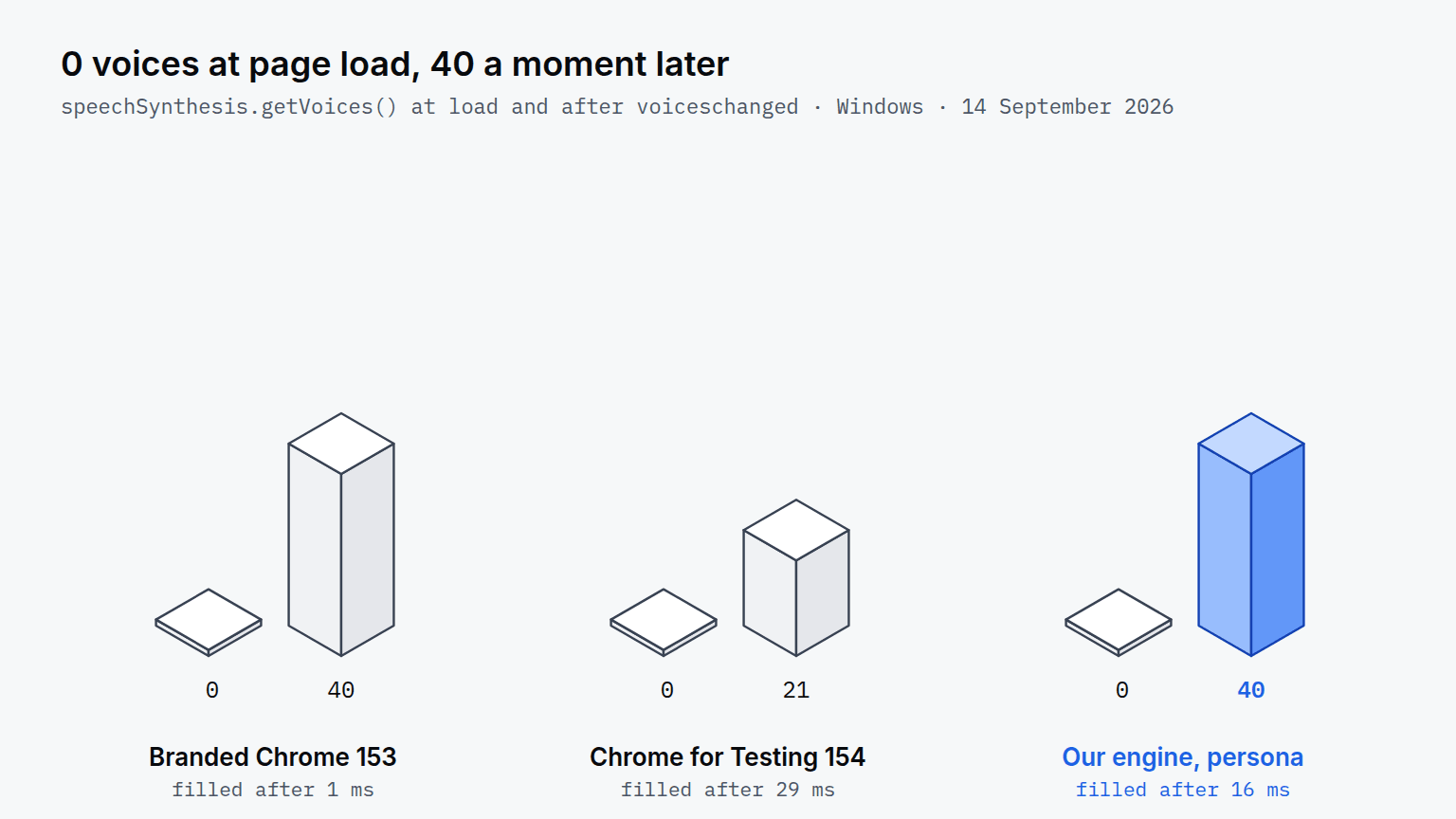
The list with a persona matched branded Chrome entry for entry: 40 voices in the same order, with the same flags and the same single default, the machine's own German voice. Chrome for Testing is the wrong control for this axis, because it is unbranded and never lists the 19 Google voices. A setup measured only against it reads 21 as correct and a real Chrome as the anomaly. The network voices also need a route to Google; without one, even branded Chrome lists only the local 21.
How does the voice list fingerprint a browser?
The voice list fingerprints a browser through four readings, each of which a page takes in the snippet above:
- The count and the split. 21 local plus 19 network voices describes branded Chrome on this Windows machine; 21 and 0 describes a Chromium build with a Chrome user agent.
- The names. Local voice names carry the vendor and the installed language packs, so they have to fit the platform the user agent claims.
- The default. Real Chrome marked one voice, the machine's own local default, in every control we read.
- The timing. Every browser we measured started at 0. A list that is complete when the page starts describes no Chrome.
These are lists a page can enumerate, and like the font list they have to match the machine underneath. On 25 August 2026 Playwright on a Linux server reported 0 voices at page load and still 0 after 2.5 seconds, while real Chrome on Windows reported 0 and then 40. That says nothing about Playwright; it describes a Linux machine without voices, and an agent on such a server that claims to be Chrome on Windows contradicts itself at once. The ways an agent can say who it is are covered in Verified bots and Web Bot Auth.
Why must the list be read as a time series?
The list must be read as a time series because a single reading, taken at the wrong moment, sees half of it. A probe that stops at the first voiceschanged can catch the list before the second group has arrived, and our own measurements did exactly that: our 151 engine was written up twice as missing voices it did have. Since then every reading of this axis is 17 samples over 16 seconds, and the verdict uses the whole series, never the first sample alone.
What went wrong in our own voice lists?
Two results went against us on this axis, and both are fixed. Our 150 build handed out 19 voices at page load, where every real Chrome shows 0, and never added the machine's 21 local voices: over 17 readings in 16 seconds it stayed at 19. The persona's list replaced the machine's voices instead of joining them, and that was fixed in the 151 package.
The second was found on 12 September 2026, when our 151 engine with a persona marked 2 voices as default where all three controls marked 1. The specification allows a default flag on "at most one voice per language", and the two flagged voices had different languages, so both were legal on paper; no real Chrome we read produced them. We fixed it on 13 September, and the table above is the 154 engine one day later with a single default.
To check your own setup, run the snippet in the browser your agent uses and in branded Chrome on the same machine, and compare all four readings. The page on testing your setup lists further ways to see what a page reads.