X API pricing in 2026: 10,000 post reads now cost 50 USD
What the X API costs in 2026: 0.005 USD per post read, 0.015 to create one, a 3 million read cap, and what a logged-out browser agent reads for nothing.

Elias Auer · Researcher, Scalebrowser
Published Oct 13, 2026 · 6 min read
Short answer
You launched a product on Tuesday and you want to read every reply on X. You ask your agent what that costs, and it answers with a unit instead of a plan: 0.005 USD per post read. Half a cent is also the whole bill, because there is no seat price and no tier to pick. Here is what the unit adds up to, what changed on 6 February, and what the same job costs in a browser.
How much does the X API cost?
The X API charges 0.005 USD for each post it returns and 0.015 USD for each post you create. The prices come from X's pricing page, which we read on 11 October 2026; the last column is our arithmetic on those prices.
| Action | Price | Unit | Per 1,000 |
|---|---|---|---|
| Read a post | 0.005 USD | per post returned | 5 USD |
| Look up a user | 0.010 USD | per user returned | 10 USD |
| Read your own data | 0.001 USD | per resource | 1 USD |
| Create a post | 0.015 USD | per request | 15 USD |
| Create a post with a URL | 0.200 USD | per request | 200 USD |
| Monthly read cap | 3,000,000 reads | per billing cycle | 15,000 USD at the cap |
Credits are bought upfront in the Developer Console and used up as requests are made, and you can set a spending limit per billing cycle. A post you read twice on the same UTC day is billed once; X calls that a soft guarantee. Past 3 million reads in a month you need an Enterprise plan.
What happened to the free and Basic tiers?
The free tier is gone for anyone starting now: X's pricing page lists none and promises "No contracts, subscriptions, or minimum spend". X's changelog calls the old one the Legacy Free tier and dates the change in three steps.
- 20 October 2025: X announces a limited closed pilot of credit-based pricing, at 0.005 USD per post read and 0.01 USD per user read.
- 6 February 2026: pay-per-use launches. Recently active Legacy Free users get a one-time 10 USD voucher, and "Basic and Pro plans remain available, and existing subscribers can opt in to Pay-Per-Use".
- 2 October 2026: a new account earns a one-time 20 USD when it saves its first eligible payment card, and its first auto-recharge is matched up to 50 USD.
At 0.005 USD a read, the 20 USD buys 4,000 post reads and the full 70 USD buys 14,000. That is a trial, not a free tier.
What do 10,000, 100,000 and 1 million reads cost?
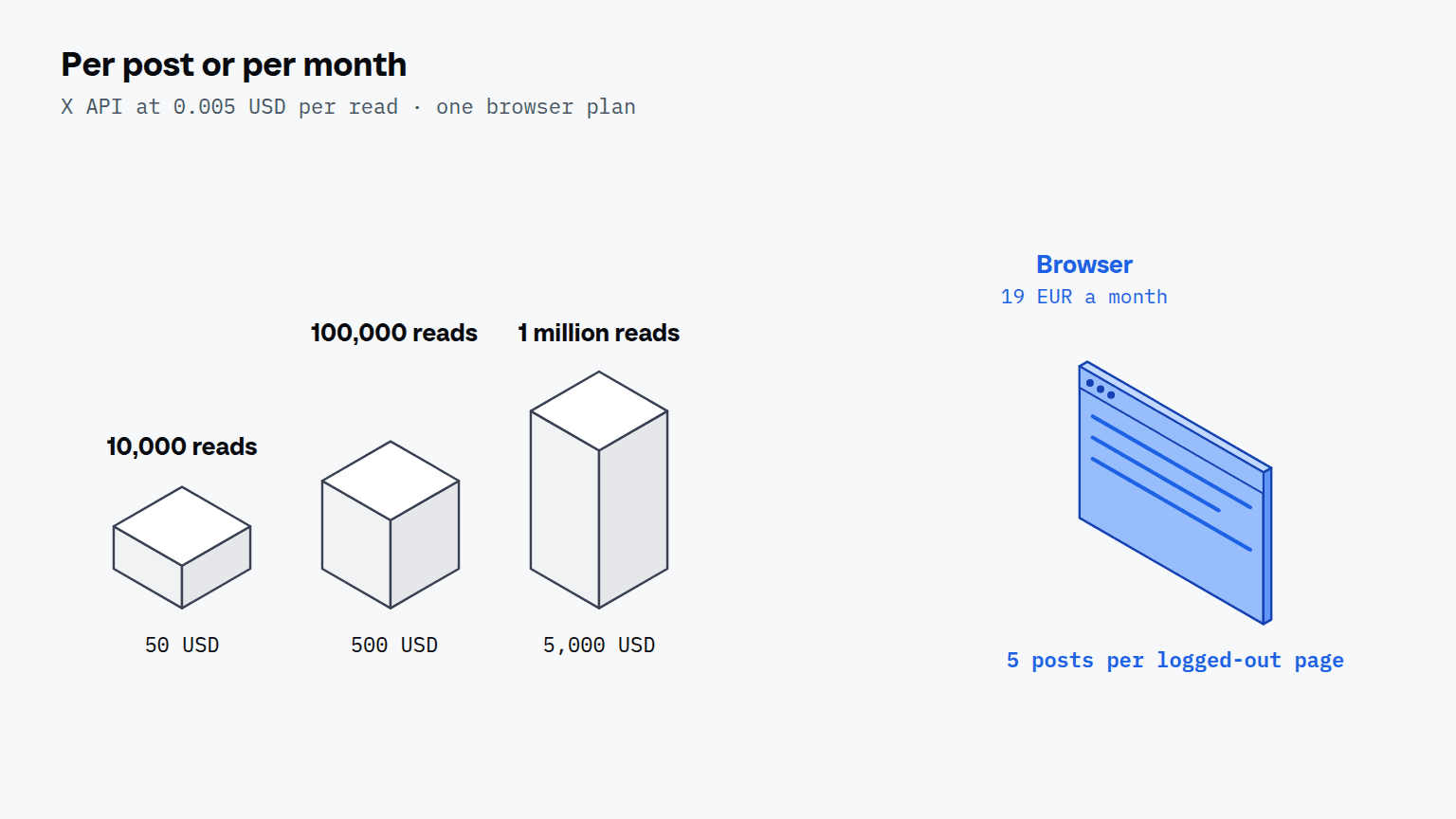
10,000 reads cost 50 USD, 100,000 cost 500 USD and 1 million cost 5,000 USD at 0.005 USD each.
| Reads per month | Cost | Per day | Share of the 3 million cap |
|---|---|---|---|
| 10,000 | 50 USD | about 333 | under 1 in 300 |
| 100,000 | 500 USD | about 3,333 | 1 in 30 |
| 1,000,000 | 5,000 USD | about 33,333 | 1 in 3 |
At 10,000 you are one person following one topic for a month, say the replies to your launch and the posts that quote it. At 100,000 you are a small team watching several brands every day. At 1 million you are running a product whose own users expect X data in it, and the bill is a line in your margin.
What does reading X cost without the API?
Reading X in a browser costs a plan instead of a price per post: Scalebrowser Start is 19 EUR a month for one browser at a time on one machine, with unlimited profiles, according to its pricing page. An agent that works reading X in an agent's browser opens the page as you would and reads it as text, so no post is billed.
What it reads depends on whether it is signed in. We measured the logged-out half on 11 October 2026: a fresh profile, no account, the pages any visitor loads, 13 page loads in about 4 minutes of wall-clock time with the agent's own turns included.
| Page | Loads | Posts visible | What ended the page |
|---|---|---|---|
| x.com/AnthropicAI | 3 | 5 each time | page ends after 5 posts |
| x.com/OpenAI | 3 | 5 each time (the first pinned) | page ends after 5 posts |
| x.com/nasa | 3 | 5 each time | page ends after 5 posts |
| x.com/search?q=browser agent | 4 | 0 | 3 sign-in dialogs, 1 error page |
After the fifth post each page ended in a bar that offered the full profile with a Continue to X button; our profile showed it in German. It was there on all 9 loads, on one of them a moment after the posts. The same 5 posts came back on every reload, so 9 profile loads read 15 different posts, which the API would bill at 0.075 USD.
Search did not work logged out: 3 of 4 loads went straight to a sign-in dialog, and the fourth showed an error page that said the page was down. We used no account, so this is the free ceiling and says nothing about a signed-in volume.


Scalebrowser gives each agent its own isolated browser with a persistent identity, on your own machine, so a run stays signed in, handles the captcha and finishes without anyone watching it.
See how Scalebrowser does itWhat stops an agent at X sign-in?
At X sign-in the agent met a dialog and no puzzle: continue with a phone number, Google or Apple, or type an email address or username. Whether a puzzle follows depends on how the site rates the visit. Our August measurement of the Arkose puzzle at sign-in tried X's login and sign-up pages among its 5 attempts and was never shown one, and on 11 October we typed no credentials into X at all.
Which route fits which reader?
A product that resells X data needs the API, and research or posting from one account fits the browser. The deciding questions are who owns the account and how many posts you need.
| Reader | Route | Why |
|---|---|---|
| A dashboard or product that resells X data | API | billed per post, no session to keep alive, 3 million reads a month before Enterprise |
| A person or team researching and posting from one account | Signed-in browser | a plan price, and the agent reads search, threads and replies as you do |
| Someone who reads a few public profiles | Logged-out browser | 5 posts per profile page, nothing to sign in to |
| A job that needs exact counts over millions of posts | API, then Enterprise | the cap and the billing are documented |
Both routes can sit behind an X MCP server, which is how an agent in Claude Desktop reaches either one. Research that has to cover X next to Reddit and LinkedIn is market research that includes X, where a fetch tool read 0 of 3 X posts.
Where does the browser run?
The browser runs on your own machine, so the account's sign-in and the posts it reads stay there. For the job pages that go with this one, see the use cases overview and tools with no API.
Run it on your own machine
Seven days to try it with your own agents on your own sites. Starting the trial needs a card.
Written by
Elias Auer
Researcher, Scalebrowser
Researcher at Scalebrowser, the browser layer for AI agents that runs on your own machine. Measures what a web page can observe about a browser, compares it with a real Chrome on the same machine and publishes the numbers, including the ones that went against us.
All articles by Elias Auer