Market research AI misses Reddit and X: 0 of 7 links read
Why AI deep research misses Reddit, X and LinkedIn, and what an agent in a browser signed in as you reads instead: 4 of 4 Reddit threads in our test.

Elias Auer · Researcher, Scalebrowser
Published Oct 13, 2026 · 7 min read
Short answer
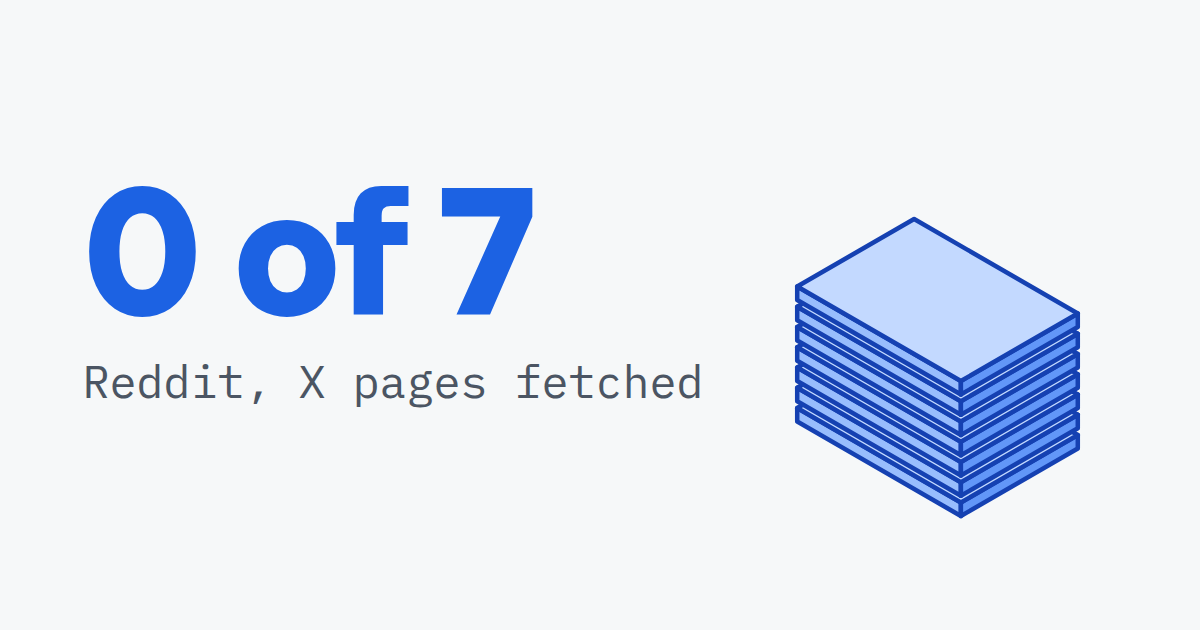
Say your deep research report arrives with 30 blog posts quoted and not one customer. You asked what developers think about the token cost of browser agents, and the answer reads like a vendor brochure. The people who have an opinion are on Reddit, X and LinkedIn, and the tool didn't get in. Here is what it misses, what we measured, and how an agent reads those places instead.
What is market research AI?
Market research AI is software that reads sources on a topic, compares what they say and writes up what customers or competitors think, with a link for each claim. It comes in two kinds. A deep research tool searches and reads the open web on its own servers, and an agent in a signed-in browser opens the sites the way you do, with your accounts.
The first kind is fast and it doesn't need anything from you. The second needs a profile per account and is the only one that can read what sits behind your login.
Which sources do research tools miss?
Research tools miss the sources that need a sign-in or turn automated readers away, and for market research those are the sources where customers talk. The list is short and it is where the opinions are.
- Reddit threads, where people post their own numbers
- X replies under a launch or a complaint
- LinkedIn posts and comments from people who run the thing you research
- paid trade press, if you hold the subscription
- review sites that show the full review only to a signed-in visitor
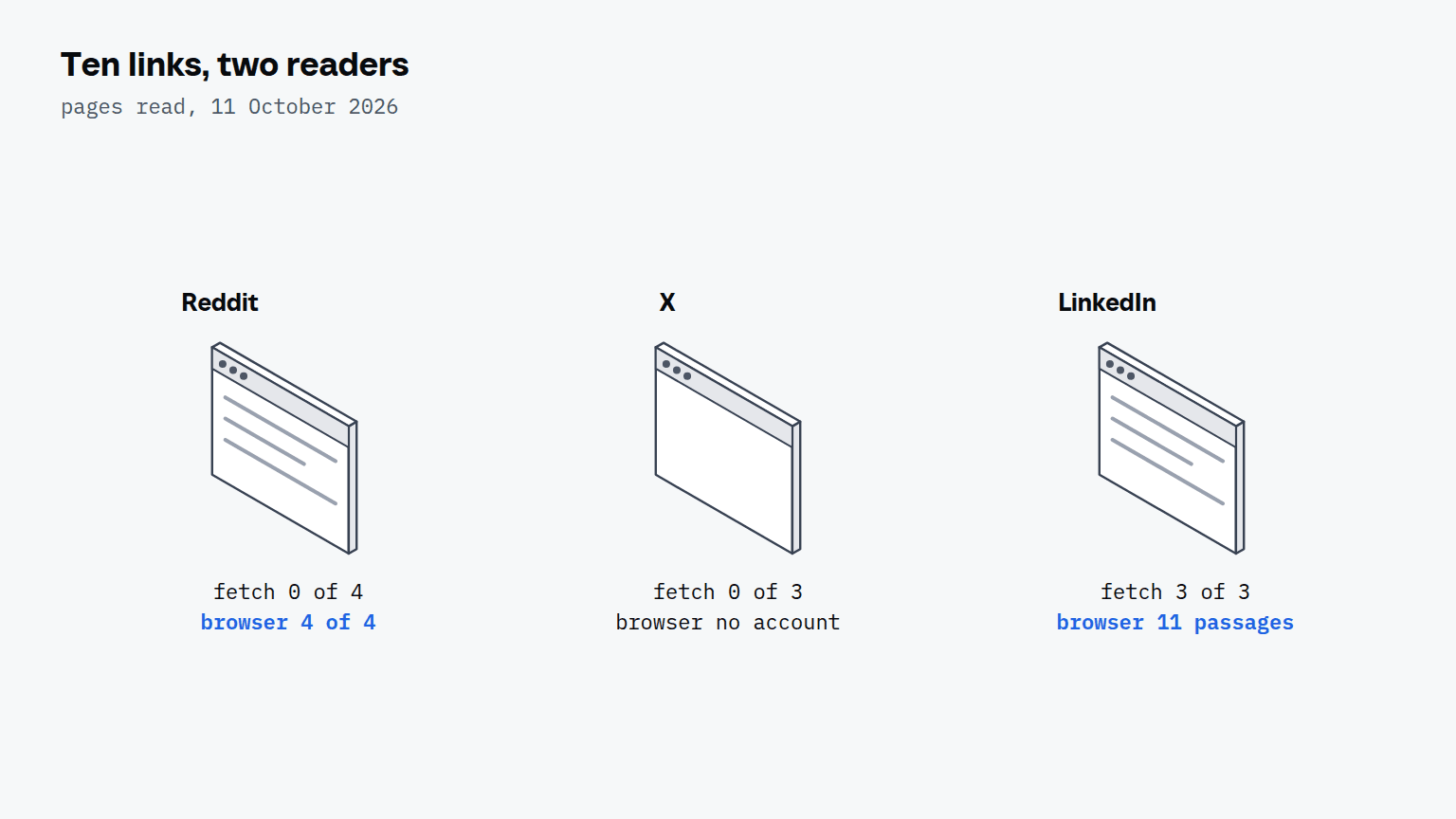
We tested the first three on 11 October 2026 with one question: what do developers say about the token cost of browser agents? As a stand-in for a deep research tool we used Claude Code's own web search and web fetch, which are what such tools are built from. Search refused Reddit outright: a search limited to reddit.com came back with an error that the domain is not accessible, and 3 unfiltered searches returned 27 links, none on Reddit, X or LinkedIn. We then took 10 links, 4 from Reddit, 3 from X and 3 from LinkedIn, and fetched each one.
| Platform | Links | Read by a fetch tool | Read in the signed-in browser |
|---|---|---|---|
| 4 threads | 0 of 4, refused for the whole site | 4 of 4 | |
| X | 3 posts | 0 of 3, HTTP 402 Payment Required | not tried, our test profile has no X account |
| 3 posts | 3 of 3, but one showed 10 of 160 comments before a sign-in bar | LinkedIn's own search returned 11 passages from posts |
The Reddit links came from Reddit's own search box in the browser, because the web search could not find any. The fetch tool read all 3 LinkedIn posts, though the one that showed its comments stopped at about 10 of 160. In the browser, LinkedIn's search returned different posts from the web search, so the 2 routes found different material, not the same material twice.


Scalebrowser gives each agent its own isolated browser with a persistent identity, on your own machine, so a run stays signed in, handles the captcha and finishes without anyone watching it.
See how Scalebrowser does itX's pricing page lists 0.005 USD per post read, with credits bought upfront and no subscription tiers, according to the X API pricing page we read on 11 October 2026. By that price a research run that reads 300 posts costs 1.50 USD, which is our arithmetic, not X's. What 10,000 or 1 million reads come to is worked out in X API cost per read. We didn't read X through the API or a signed-in profile today, so the X row has no browser number.
How does an agent read behind a sign-in?
An agent reads behind a sign-in by working in a browser profile that is already signed in to your account, one profile per account, with the session kept between runs. You sign in once, and the stored password never enters the chat. After that, the agent opens Reddit or LinkedIn the way you would and reads the page as text, which is how research in a signed-in browser differs from a fetch.
A subscription works the same way: a profile signed in to a trade-press site you pay for reads what you read. We haven't run that case yet, so this article reports Reddit and LinkedIn only. Two platforms need their own few lines.
How does the agent search X?
On X the agent can use the API at a price per post, or a browser signed in to an account you own. Searching X through MCP compares the two, and the price above is the API side of that comparison. In our test the fetch tool got HTTP 402 on 3 of 3 X posts and our profile had no X account, so we report the fetch result and nothing more for X.
How does the agent read LinkedIn?
On LinkedIn the agent searches the site's own box and reads the posts it returns, as you would. The official API opens only 3 permissions without approval, so most reading happens in the browser, as reading LinkedIn as yourself shows with company pages. In the research run, LinkedIn's search returned 11 passages that mention tokens, and most of them promoted a tool, while the Reddit threads carried the per-run dollar figures.
What does a research run look like?
A research run on one question took 233 seconds of browsing in our test: 26 tool calls from opening reddit.com to releasing the profile, with the agent's own turns included. You type: "What do developers say about the token cost of browser agents? Read the best threads on Reddit and LinkedIn and give me the numbers with links." The agent opens Reddit signed in as our test account, types the question into the search box and opens 4 threads one by one. Then it runs the same question in LinkedIn's search and reads the results.
What comes back is a summary where each number points at the thread it came from. These are the posters' own figures, not ours, and we didn't check them.
| Thread | The number it gives | Poster's claim about |
|---|---|---|
| r/AI_Agents, plan-then-execute | 20 to 50 model calls and 0.50 to 3.00 USD per task for an agent loop; 1 call and 0.01 to 0.05 USD after the switch | a browser agent at Claude Sonnet 4.6 prices |
| r/AI_Agents, a week of runs | 61 runs, 15.4 million tokens, 37.68 USD: about 0.62 USD and 250,000 tokens a run | agent runs in general, not only browsing |
| r/hermesagent, a lean browser tool | 13,700 tokens of tool definitions for Playwright MCP against about 1,900 for the poster's 5 tools | tool definitions that load on every request |
| r/WebScrapingInsider, Browser Use against Playwright | no figure, only that latency and token cost spiral when an outside harness observes and decides at every click | the loop itself |
The spread is the finding. One commenter on the week-of-runs thread reported runs under 2 cents each and put the gap at about 300 times in cost, so "a run costs X" says little until it says what the run does. Every row is a claim by one person, which is why the agent links each one instead of averaging them. A question you want checked every morning rather than once is a different job; a Reddit monitoring round read 125 new posts in 5 subreddits and found 7 that matched.
Can Claude Code run the research?
Yes, if a browser is attached: we ran this one from Claude Code with a browser connected, and its own search and fetch covered the open web while the browser covered the rest. The search found 27 links on the open web and none on Reddit, X or LinkedIn, so the browser supplied every thread above. How Claude Code gets that browser is covered in Claude Code with a browser.
Where does the browser run?
The browser runs on your own machine, so the accounts and subscriptions in its profiles stay with you: Scalebrowser Start costs 19 EUR a month for one browser at a time on one machine, with unlimited profiles, according to its pricing page. For the job pages that go with this one, see the use cases overview and agents that sign in.
Run it on your own machine
Seven days to try it with your own agents on your own sites. Starting the trial needs a card.
Written by
Elias Auer
Researcher, Scalebrowser
Researcher at Scalebrowser, the browser layer for AI agents that runs on your own machine. Measures what a web page can observe about a browser, compares it with a real Chrome on the same machine and publishes the numbers, including the ones that went against us.
All articles by Elias Auer