Zillow API: listings are invite-only, the website isn't
Zillow's listing data is invite only. How an AI agent searches zillow.com like you do instead, and what 5 signed-out runs on 11 October 2026 showed.

Elias Auer · Researcher, Scalebrowser
Published Oct 25, 2026 · 5 min read
Short answer
Every evening a couple opens Zillow and types the same search: 3 bedrooms in Austin, under 450,000 USD. On 11 October 2026 that city showed 5,754 results for sale, and the first three cards cost 475,000, 1,149,900 and 535,000 USD, so none fitted. They scroll until they find one that does, close the laptop, and do it again the next evening. This is the job an agent can take over, and the first question is whether Zillow has an API for it.
Is there a Zillow API?
Yes, Zillow Group lists close to 20 APIs, but the one a home search needs, listing data, is invite only. The Zillow Group developer site groups its APIs under agents, MLS and broker listings, mortgage, public data, rentals, transactions and Zestimates, and says they are available to the public as well as to partners. Listings for sale run through the Bridge Listing Output platform. Its MLS listings page says "The platform is currently invite only" and that "All data access is at the discretion of our individual MLS partners in the US and Canada."
For a new developer the answer to "is the API still available" is therefore split. The rentals, public data and Zestimate APIs are listed; the feed of homes for sale is something an MLS partner grants, one MLS at a time. What replaced the open listing API, for a person who is not an MLS partner, is the website itself, and an agent reads that the way you do.
What can an agent do on Zillow?
An agent does on Zillow what you do with a mouse and a notepad. These are prompts you can give it:
- Check my saved search and tell me which homes are new since yesterday.
- Compare the price history of my 5 favourites and say which one dropped most.
- Put the shortlist in a sheet with price, bedrooms, bathrooms and square feet.
- Draft a message to the listing agent of the second home and ask about the roof.
- Cross-check the same homes on Redfin and flag any that differ.
A saved search and a price history sit behind your Zillow sign-in, and we used no account for this article. What we measured is the signed-out search, which is the same first step in every one of these prompts.
What happens at Zillow's press-and-hold check?
In 5 of 5 runs on 11 October 2026, nothing on Zillow asked for a press and hold. We opened signed-out search pages with a fresh profile and no account, 5 loads in all, and timed each one from the request to a loaded result list. The times include the agent's own turns, so they are an upper bound.
| Run | Search | Results shown | Seconds to a result list | Press-and-hold check |
|---|---|---|---|---|
| 1 | Austin, TX | 5,754 | 23 | none |
| 2 | Denver, CO | 3,965 | 14 | none |
| 3 | Seattle, WA | 3,158 | 23 | none |
| 4 | Austin, TX | 5,754 | 17 | none |
| 5 | Austin, TX, page 2 | 5,754 | 12 | none |
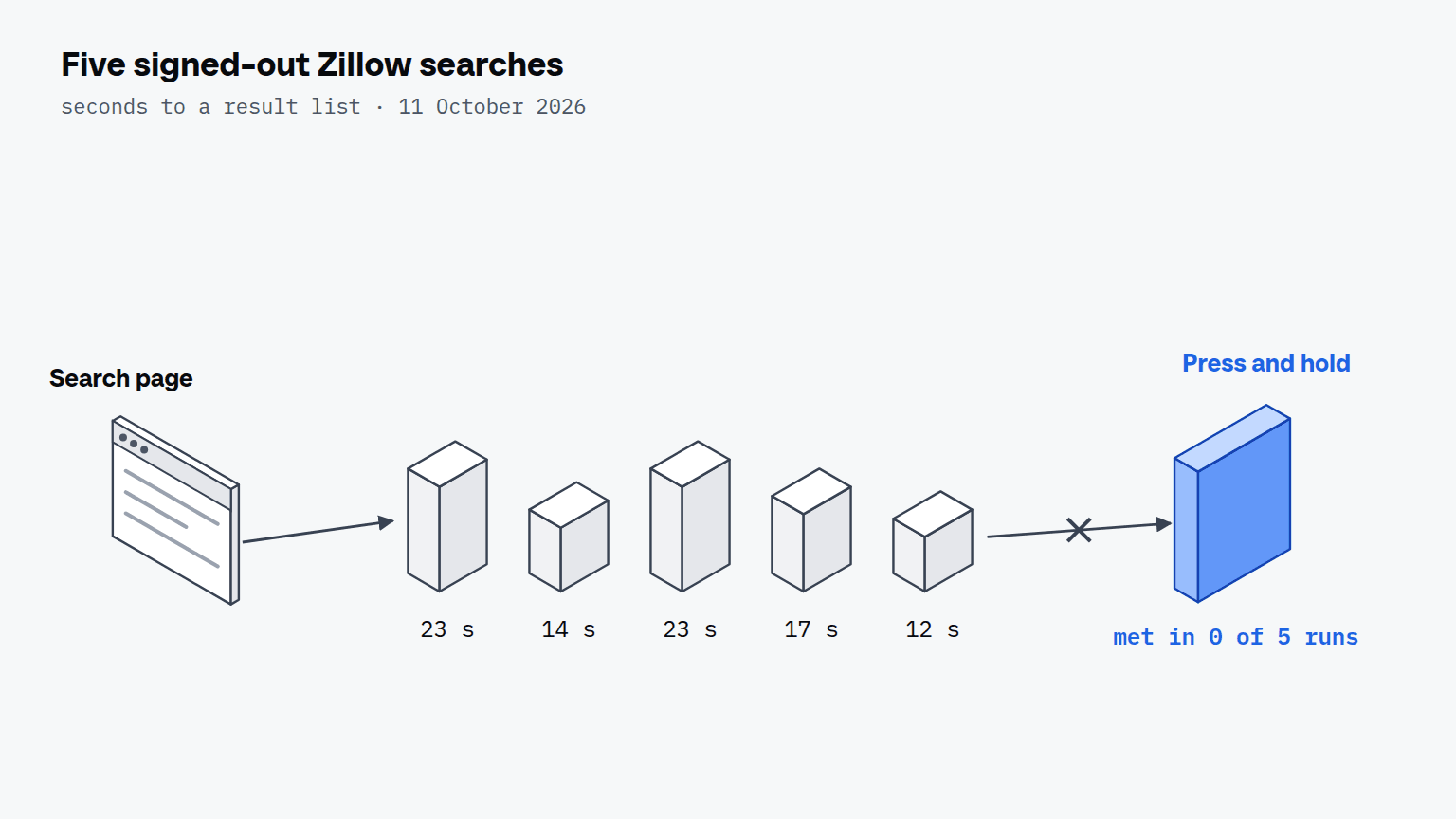
That is a result for 5 loads on one day, not a promise about the next one: a site decides per visit whether to ask. Zillow's page carried no widget to press, so the press-and-hold check on Zillow remained a case we were only ready for. The agent's tool for it, press_and_hold, is measured with 17 other challenge types in the linked article.


Scalebrowser gives each agent its own isolated browser with a persistent identity, on your own machine, so a run stays signed in, handles the captcha and finishes without anyone watching it.
See how Scalebrowser does itWhat does a home search run look like?
A home search run starts with one page request and ends with a short list of homes you have not seen. On 11 October 2026 our agent opened the Austin search signed out, and the page answered with "5,754 results" in the order Zillow calls "Homes for You". The agent read each card as text: a price, an address, beds, baths and square feet, the brokerage that listed it, and sometimes a label such as "Open: Sun 12-2pm (10/11)".
From there the evening job is a routine, not a conversation. Scalebrowser's workflow tools, 3 of them (record, compile and run), record one search and replay it later; every element is found again on the page as it is, and the pauses are drawn fresh for the profile. The agent then keeps the addresses it has already shown you, and each round it reports only the homes whose addresses are new.
The couple's search would end with a short message that lists only the new homes, each with its price and bedrooms. We did not run the signed-in half for this article, so what a saved search would return is not part of our measurement.
Can the same agent compare Zillow and Redfin?
Yes, the agent opens Redfin in a second tab of the same profile and puts both lists into one sheet, matched by address. You ask once, for example "show me every home that is on both sites and flag a price that differs". We did not measure Redfin for this article, so we make no claim about what a signed-out Redfin search returns.
Where does the browser run?
The browser runs on your own machine, so a signed-in Zillow session stays in a profile there; the browser behind a home search is described in the article on browser agents. For the other jobs an agent's own browser takes on, see the use cases overview and tools with no API.
Run it on your own machine
Seven days to try it with your own agents on your own sites. Starting the trial needs a card.
Written by
Elias Auer
Researcher, Scalebrowser
Researcher at Scalebrowser, the browser layer for AI agents that runs on your own machine. Measures what a web page can observe about a browser, compares it with a real Chrome on the same machine and publishes the numbers, including the ones that went against us.
All articles by Elias Auer